DONGFANG TURBINE · STEAM TURBINES
Cogeneration Steam Turbines
Dongfang steam turbine arrangements for electricity generation with useful heat supply. Compare back-pressure, deep-back-pressure and extraction-condensation-back-pressure options, then define the heating duty and steam balance required by your project.
- Catalogue forms
- Three separately listed arrangements
- Heating applications
- Industrial and district heating
- Operating-mode entry
- Extraction-condensation-back pressure
PRODUCT OVERVIEW
Cogeneration.
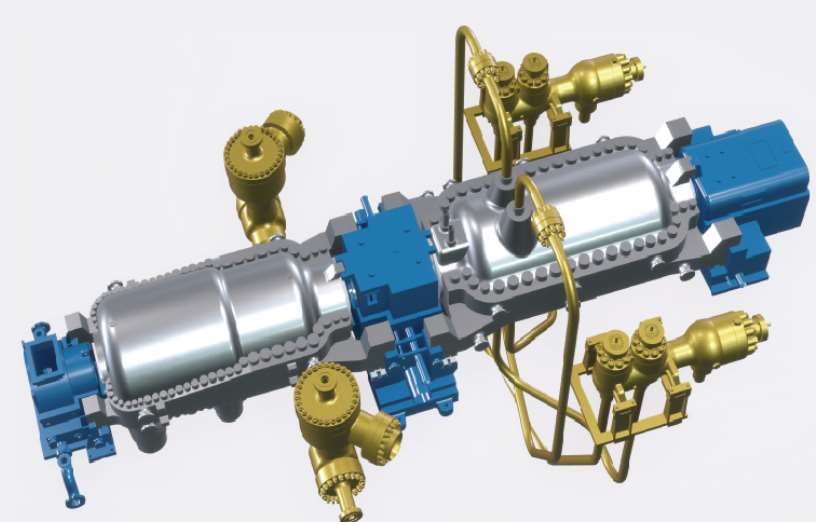
The catalogue identifies cogeneration duties in industrial processing, captive power plants and district or regional heating. The useful-heat requirement forms part of the turbine duty.
Three separately listed arrangements provide different back-pressure and operating-mode references. CHENDA brings your electricity and heating requirements together for clarification with the manufacturer.
CATALOGUE REFERENCE
Series parameters.
Compare each row as a separate catalogue reference. Final selection depends on the complete operating duty.
Scroll the table horizontally to see every parameter, source and enquiry link.
| Series / arrangement | PowerMW | Inlet / reheat notation | Exhaust pressure / mode | Speedrpm | SourcePDF page | Enquiry |
|---|---|---|---|---|---|---|
| Back pressure (suction) units — source wording | ≤200 | ≤24.2 MPa, 566℃ | 0.1–12 MPa | ≤8000 | p. 13 ↗ | |
| Reheating deep back pressure | ≤200 | ≤24.2 MPa, 566℃ | As low as 0.1 MPa | ≤6000 | p. 13 ↗ | |
| Extraction-condensation-back pressure mode | ≤200 | ≤24.2 MPa, 566℃ | Condensation; pressure: Not stated | ≤6000 or 3000 | p. 13 ↗ |
“As low as” is retained as written; it is not replaced by an arbitrary lower or upper pressure inequality.
The catalogue’s “suction” wording remains a terminology clarification, while the numerical parameters can still be used as stated.
The parameter blocks do not identify the MPa pressure reference or a full electrical-output and heat-flow operating matrix.
Full source reading notes
Source: S01, PDF physical pages 10–23. Parameter rows are on pp.10, 11, 13, 15, 18, 19, 21 and 22–23; each row retains its own source page. The general source link opens the first relevant page, p.10.
Each row is a separate catalogue series, arrangement or explicitly labelled section overview. Descriptive arrangement names are not invented model numbers. Values from different rows must not be combined into one operating duty.
An upper limit such as ≤100 MW does not state a minimum power. Temperatures are reproduced without adding an independent ≤ symbol where the source does not show one. The 24.2 MPa value for the 80–200 MW residual-heat row is reproduced without adding ≤.
Biomass inlet pressure is explicitly 8–14 MPa.a (absolute). Other pressure entries retain MPa because the catalogue does not identify absolute or gauge pressure for those rows.
The catalogue cover describes 100 kW–200 MW, while the solar-thermal DCSP-3 row on p.15 explicitly states 350–660 MW. Keep both source scopes distinct: 200 MW is not a universal limit for every product, and DCSP-3 does not extend the combined-cycle or mechanical-drive families to 660 MW.
For cogeneration on p.13, "suction" is retained from "Back pressure (suction) units"; it is not silently reinterpreted as an extraction guarantee. The exhaust statement "as low as 0.1 MPa" and the extraction-condensation-back-pressure mode are retained separately.
For the dual-speed waste-to-energy row on p.19, ~13 MPa is an approximate inlet value, not 6–13 MPa or ≤13 MPa. The speed notation 5000 / 3000 rpm is not a continuous speed range.
For biomass XTS-I on p.21, high-speed operation is described but no numerical speed is stated. XTS-II explicitly lists 5025 / 3000 r/min, reproduced here under the rpm column. Do not borrow numerical values from adjacent series.
The combined-cycle overview combines page-specific references, not an equipment selection matrix: p.22 states power ≤200 MW and speed ≤13000 rpm; p.23 states high-parameter design up to 16 MPa / 600℃. The brochure does not establish that all these limits occur together in one model.
Not stated means that the relevant series parameter block gives no value. Development timelines and project examples are not additional product-series ranges. ORC and natural-gas differential-pressure products use different working fluids and are not merged into this steam-turbine table.
Series scope.
- Back-pressure and reheating deep-back-pressure entries have different exhaust and speed descriptions.
- The extraction-condensation-back-pressure entry describes an operating mode, with condensation stated in its exhaust field.
- The catalogue retains the wording “Back pressure (suction) units”; its meaning should not be silently expanded into an extraction specification.
SOURCE DOCUMENTS
Technical literature.
Source file: ★2026 Industrial Turbines of DTC-外发版(英文).pdf
START YOUR ENQUIRY
Bring the key information together.
Send the details you already have. CHENDA will coordinate open technical questions with the manufacturer.
- Required electrical output and useful-heat duty
- Available inlet steam pressure, temperature and flow, with pressure reference
- Heating or process-steam pressures, temperatures and required flows
- Expected operating modes, heat-demand variation and seasonal conditions
- Exhaust or condenser conditions and required supply scope
- Project location, stage, quotation requirements and target timing
Questions about this series.
Which heating requirements should accompany an enquiry?
Provide the required steam conditions and flow at each heating or process connection, together with electrical output and expected changes in demand. Unknown items can remain clarification points.
Does the catalogue define an extraction-flow schedule for every arrangement?
The cited parameter blocks do not provide a complete extraction-flow distribution. The manufacturer needs the project steam balance to assess the required operating modes.